
9 Downstairs Toilet Ideas That Actually Work in Real Homes
The downstairs toilet is often treated as an afterthought, squeezed in under the stairs, finished last, and designed around whatever happens to fit. Yet it’s one of the most frequently used rooms in the house, and often the only bathroom your guests ever see.
The good news is that a small space doesn’t limit good design, it encourages it. With fewer elements to consider, every decision matters more. Colour, lighting, materials, and layout all have a bigger impact in a downstairs toilet than they do in a full‑size bathroom.
This also makes cloakrooms the perfect place to be a little braver. You can experiment with bolder finishes, richer colours, or more characterful details without overwhelming the rest of your home. When it’s done well, a downstairs toilet doesn’t just feel practical, it feels intentional.
The ideas below focus on what actually works in real homes: how to make a small space feel considered, comfortable, and quietly impressive.
1. Design It Like a Room, Not Just a Toilet
One of the biggest mistakes with downstairs toilets is treating them as purely functional. A toilet, a sink, a light… job done. But the most successful cloakrooms are designed in the same way you’d approach any other room in the house.
Before choosing fixtures or tiles, it helps to think about how you want the space to feel. Should it be calm and understated? Dark and dramatic? Light and welcoming? Once you decide on the mood, the individual choices like colour, materials and lighting start to make more sense.
Because the space is small, you don’t need many elements to create impact. A single wall colour carried across all four walls can feel far more intentional than a mix of safe neutrals. Likewise, one considered material, whether that’s a textured tile, timber detail, or stone finish, will do more for the space than several competing features.
Designing your downstairs toilet as a “room” also encourages better flow. Instead of squeezing items in wherever they fit, you start thinking about balance, proportions, and how the space is experienced the moment someone steps inside.
Get this part right, and everything else becomes easier.
2. Use Wall‑Hung Fixtures Where They Make Sense
Wall‑hung toilets and basins are often recommended for small downstairs toilets, and for good reason, but they’re not a universal fix. Used well, they can make a compact space feel lighter and more considered. Used poorly, they can feel awkward or over‑engineered.
The main benefit of wall‑hung fixtures is visual space. Seeing more of the floor creates a sense of openness, which can be especially helpful in narrow cloakrooms or rooms tucked under the stairs. A concealed cistern also removes visual clutter, leaving you with a cleaner, more streamlined look.
However, wall‑hung doesn’t automatically mean better. In some very tight spaces, a compact floor‑standing toilet with a slim projection can actually fit more naturally and avoid awkward proportions. The key is scale, not whether something is wall‑mounted, but whether it suits the room.
The same applies to basins. Wall‑mounted or corner basins can work brilliantly in cloakrooms, but only if they still allow comfortable hand‑washing. A basin that’s too shallow or too narrow might look neat, but it can quickly become frustrating to use.
The best downstairs toilets balance appearance with comfort. When fixtures are chosen with both in mind, the room feels effortless, not forced.
3. Go Bold Where You’d Be Cautious Elsewhere
If there’s one room in the house where bold choices really pay off, it’s the downstairs toilet. Because it’s a space you use briefly, and often without natural light, it can handle much stronger design decisions than a main bathroom or living area.
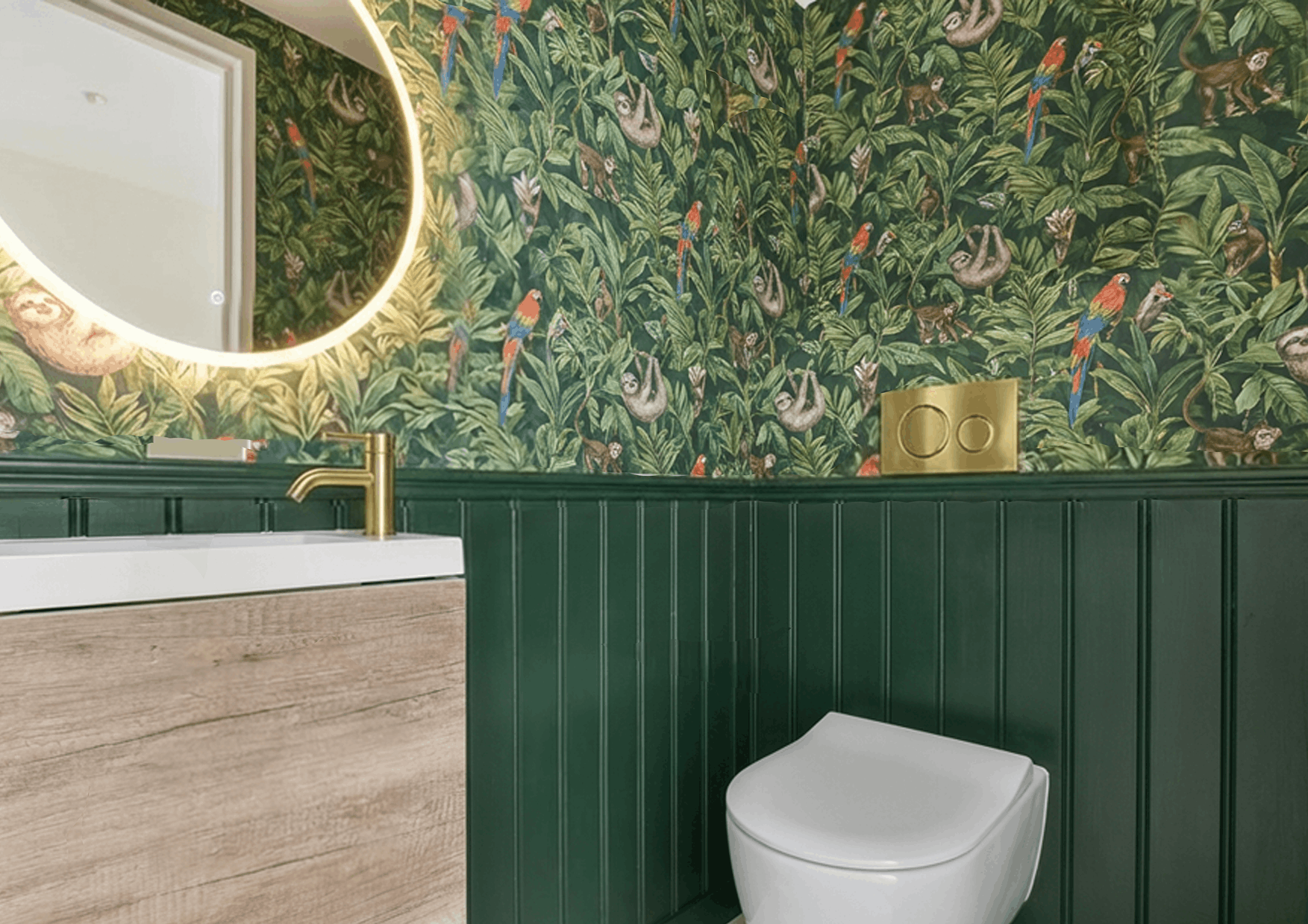
This is where deeper colours, richer textures, and statement finishes come into their own. Dark greens, inky blues, charcoal greys, or even near‑black walls can feel cocooning rather than oppressive in a small space. Paired with good lighting, they create a sense of drama that feels deliberate and sophisticated.
Tiles are another opportunity to be braver. Patterned floors, vertically stacked wall tiles, or a single feature wall can completely change the character of the room. In a compact cloakroom, one bold surface is often more effective than trying to spread interest across every wall.
Wallpaper also works particularly well in downstairs toilets. Whether it’s a subtle texture or a strong print, it adds depth and personality without needing much else in the room. The key is restraint, one confident idea, supported by simpler choices elsewhere.
When done thoughtfully, bold design in a downstairs toilet doesn’t feel risky. It feels considered and memorable.
4. Think Vertically, Not Horizontally
In a downstairs toilet, floor space is precious. One of the easiest ways to make a small cloakroom feel cramped is by filling it with furniture that spreads outward rather than upward.
Vertical thinking changes that. Instead of wide vanity units or bulky storage, look for opportunities to use the height of the room. Slim shelving above the toilet, a tall mirrored cabinet, or recessed niches built into the wall can all provide storage without eating into valuable floor area.
Mirrored cabinets are particularly effective in small spaces. They serve two purposes at once: storage and light reflection, which helps the room feel brighter and more open. The key is choosing something shallow and well‑proportioned so it feels intentional rather than utilitarian.
Open shelving can also work well in downstairs toilets, especially when it’s styled simply. A couple of neatly folded hand towels, a small plant, or a discreet storage basket can add character without clutter.
By keeping the floor clear and using vertical space wisely, the room feels calmer, easier to use, and far more considered.
5. Treat Lighting as a Design Feature, Not an Afterthought
Lighting can make or break a downstairs toilet, especially in spaces without natural light. Yet it’s often reduced to a single ceiling spotlight, which tends to flatten the room and strip it of atmosphere.
A more considered approach layers light. Wall lights either side of the mirror or a softly backlit mirror create a warmer, more flattering glow and instantly elevate the space. These sources of light also draw attention to key features, helping the room feel more intentional.
Ceiling lighting still has a role, but it works best as supporting light rather than the main event. Recessed spotlights or a small, well‑chosen pendant can add depth without overpowering the room.
Colour temperature matters too. Warm white lighting tends to work better in cloakrooms, creating a welcoming, relaxed feel rather than a stark, clinical one. This is particularly important when paired with darker wall colours or textured finishes.
When lighting is treated as part of the design, even the smallest downstairs toilet can feel inviting, polished, and thoughtfully put together.
6. Let Materials Do the Heavy Lifting
In a small downstairs toilet, materials take on a much bigger role than they do in larger rooms. With fewer elements in the space, every surface is more noticeable, which means the quality and texture of materials really matter.
This is where tiles, ceramics, and finishes can quietly elevate the entire room. Stone or marble‑effect tiles add depth and softness, while textured tiles introduce interest without relying on pattern. Even simple layouts feel more refined when the material itself has character.
Mixing finishes can also work beautifully in a cloakroom, as long as it’s done with restraint. Pairing brushed brass taps with a darker wall colour, or matte black fittings against lighter stone, adds contrast and intention. The goal isn’t to match everything perfectly, but to make choices that feel cohesive.
Because the room is small, you can often afford to invest a little more in materials without the cost escalating dramatically. One well‑chosen surface can define the entire space — doing more work than multiple decorative elements ever could.
In downstairs toilets, materials don’t just support the design. They are the design
7. Mirrors That Do More Than Reflect
Mirrors are one of the most powerful tools in a downstairs toilet, yet they’re often chosen as an afterthought. In a compact space, the right mirror can completely change how the room feels.
Larger mirrors tend to work better than small ones, even in very tight cloakrooms. A mirror that spans the width of the basin, or even most of the wall, helps bounce light around the room and creates the illusion of depth. This is especially effective in spaces without windows.
The style of the mirror also sets the tone. Frameless mirrors feel clean and modern, while framed designs can add warmth, contrast, or a more traditional feel depending on the finish. A thin metal frame can subtly tie in with taps or accessories without feeling overdone.
Mirrored cabinets are another smart option, offering discreet storage without introducing visual bulk. When chosen carefully, they blend seamlessly into the design and help keep surfaces clear.
In a downstairs toilet, a mirror isn’t just functional, it’s an opportunity to enhance light, space, and character all at once.
8. Custom or Semi‑Bespoke Makes a Huge Difference
Downstairs toilets rarely come in neat, standard shapes. They’re often tucked under stairs, squeezed into corners, or shaped around structural quirks, which is why off‑the‑shelf solutions don’t always work as well as they should.
Custom or semi‑bespoke furniture allows the room to be designed around its actual proportions, rather than forcing the space to accommodate generic units. A slimline vanity built to the right depth, a floating unit that clears the floor, or a cabinet designed to fit neatly into an alcove can transform how usable the room feels.
Bespoke doesn’t have to mean excessive or expensive. Often, small adjustments, like altering the width, finish, or configuration of a unit, make all the difference. The result is a space that feels intentional rather than compromised.
In a room where every centimetre counts, tailoring the furniture to the space can be the difference between something that merely fits and something that truly works.
9. Finish It Like a Boutique Hotel Bathroom
What separates a nicely finished downstairs toilet from a truly memorable one is attention to detail. Boutique hotel bathrooms rarely rely on size or excess, they focus on atmosphere, texture, and how the space feels to use.
Soft, high‑quality hand towels, a discreet soap dispenser, or a subtle scent instantly elevate the room. A small piece of artwork, a framed print, or even a simple ledge with one carefully chosen object adds personality without clutter.
Plants can work well too, especially in otherwise hard‑edged spaces. A small trailing plant or a low‑maintenance option can soften tiles and ceramics, bringing warmth into the room.
One of the simplest ways to create cohesion is by echoing finishes. If your taps are brushed brass or black, carry that finish through to hooks, flush plates, or mirror frames. It’s a quiet detail, but it makes the space feel resolved.
In a downstairs toilet, these final touches don’t just decorate the room, they complete it.
Downstairs Toilets FAQs
What is the best layout for a small downstairs toilet?
The best layout is usually the simplest one. Keeping the toilet and basin aligned along one wall helps maximise floor space and makes the room easier to move around in. In very narrow cloakrooms, placing the toilet at the end of the room with a compact or corner basin can prevent the space from feeling tight.
More than anything, comfort matters. Fixtures should fit the room without feeling squeezed in.
How small can a downstairs toilet realistically be?
Even very small spaces can work, provided the layout is well considered. Compact toilets, wall‑mounted basins, and shallow units are designed specifically for cloakrooms and can make a big difference.
That said, usability should always come first. A space that technically fits everything but feels awkward to use will never feel like good design.
Do dark colours work in downstairs toilets?
Yes, and often better than light ones. Dark colours can make small spaces feel cocooning and intentional rather than cramped, especially when paired with good lighting and reflective surfaces like mirrors or metallic finishes.
The key is balance: thoughtful lighting and a clear design direction stop darker schemes from feeling heavy.
How can I make a downstairs toilet feel more luxurious?
Luxury in a downstairs toilet comes from materials and details rather than size. High‑quality taps, textured tiles, considered lighting, and a few well‑chosen accessories will always have more impact than filling the room with features.
A calm, cohesive design usually feels more luxurious than anything overly decorative.
What’s the difference between a downstairs toilet and a cloakroom?
The terms are often used interchangeably. Traditionally, a cloakroom refers to a small ground‑floor toilet that may also include storage, while a downstairs toilet can be more basic. In practice, both describe the same type of compact bathroom space.
Can a downstairs toilet still feel stylish as well as practical?
Absolutely. In fact, downstairs toilets are often some of the most stylish rooms in a home because they allow for bolder choices and more focused design. When layout, lighting, and materials are considered together, even the smallest space can feel refined and intentional.